
ब्लॉग
Electric Scissors for Cloth Cutting: The Complete Buying & Use Guide

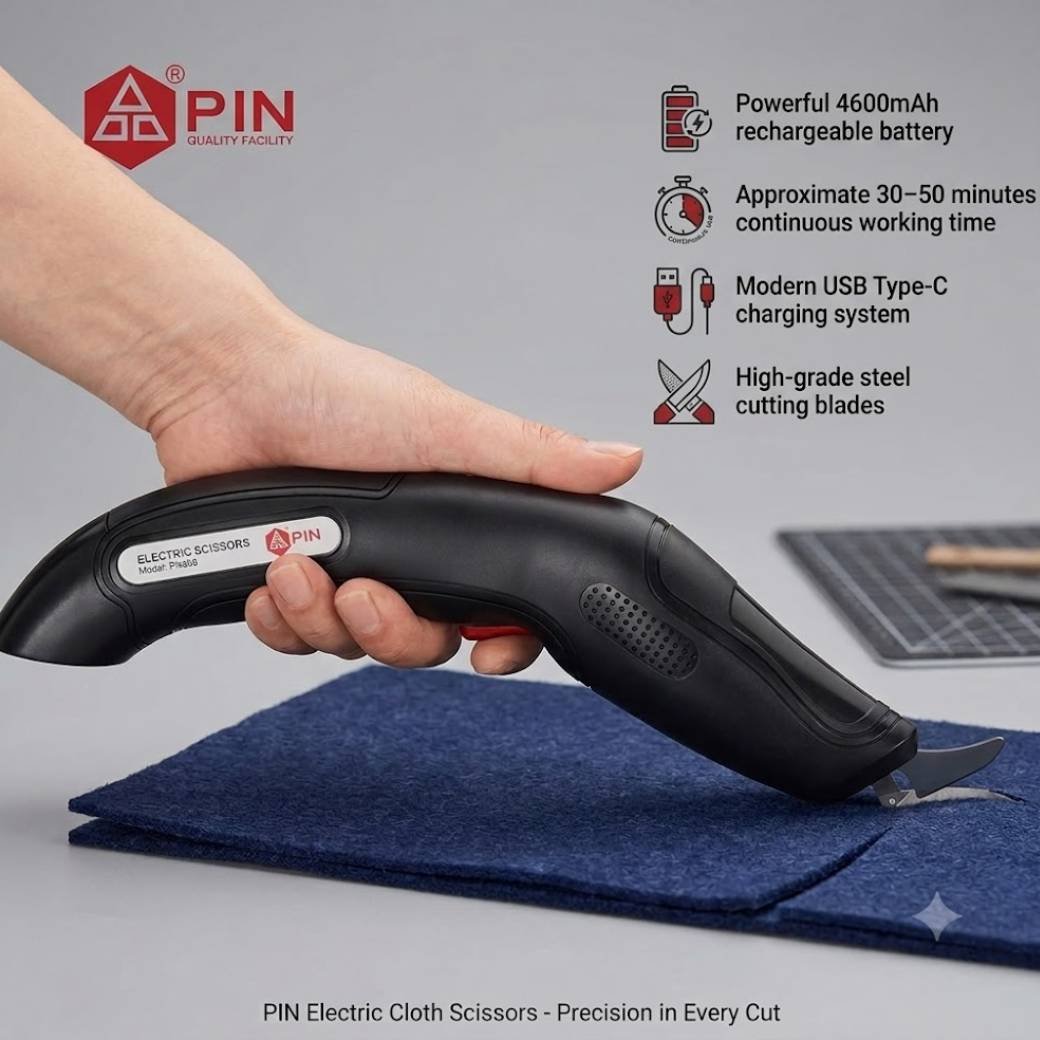

Electric scissors for cloth cutting use a small motor to drive the blade, so cutting fabric takes a light squeeze instead of the repeated hand-close motion of a manual pair. They’re built for tailors, boutiques and craft workers cutting fabric for hours at a stretch, or pushing through thick layers — denim, canvas, leather — without hand fatigue. StitchPartner stocks two cordless models, the PIN 696A and the tungsten-blade तार रहित इलेक्ट्रिक कपड़े की कैंची, both ready to use straight out of the box.
How Electric Fabric Scissors Actually Work
An electric fabric scissor isn’t just a powered version of a hand movement — a small motor drives the blade at speed, so the operator’s job is to guide the tool along the cutting line and hold a trigger, not squeeze a blade shut over and over. That’s the actual reason it reduces hand strain over a long cutting session: the effort shifts from your fingers repeatedly closing a blade to your forearm steering the tool, not because the blade itself is any sharper than a good manual pair.
Corded vs. Cordless — Which Should You Buy?
Almost every electric fabric scissor sold today, including both StitchPartner models, is cordless: a rechargeable lithium battery in the handle, topped up over USB or a wall adapter between shifts. The real trade-off isn’t corded-vs-cordless so much as runtime vs. price. The PIN 696A runs roughly 30–50 minutes continuously on its 4600mAh battery and recharges over USB-C — enough for a boutique doing short cutting sessions between customers. A factory cutting fabric non-stop through a shift should plan on a charged spare rather than expect all-day runtime from a single charge, since neither model is marketed for continuous full-shift use.
What Can You Actually Cut With One?
Between the two StitchPartner models, verified cuttable materials include cotton, polyester, denim, silk, felt, canvas, leather, upholstery, carpet, corrugated cardboard, vinyl and plastic packaging. The Cordless Electric Fabric Scissors ships with one interchangeable tungsten steel alloy head built specifically for rigid materials, so swapping heads matters more than brute motor power when you move between soft fabric and something like cardboard or vinyl.
Like most electric fabric scissors, neither model is built for fine pattern-tracing precision. For intricate curves, appliqué or embroidery trimming, a manual small sewing or tailoring scissor still does a cleaner job. Electric scissors earn their price on long straight or gently curved runs through heavy or repeated fabric — production cutting, not detail work.
PIN 696A vs. Cordless Electric Fabric Scissors
| PIN 696A | तार रहित इलेक्ट्रिक कपड़े की कैंची | |
|---|---|---|
| Battery | 4600mAh, USB-C charging | Internal Li-ion, 3-stage LED indicator |
| Runtime | ~30–50 min continuous | Not stated by manufacturer |
| Blade | High-grade steel (claimed 5–6× life vs. generic blades) | Tungsten steel alloy, interchangeable head |
| Safety lock | Not included | सुरक्षा लॉक बटन + ट्रिगर स्विच |
| कीमत | ₹2,700 (was ₹3,500) | ₹1,299 (was ₹2,499) |
| Best for | Daily boutique/tailoring use wanting a longer per-charge run | Budget buyers who want a physical safety lock and a swappable rigid-material head |
What to Check Before You Buy
- Runtime vs. your cutting sessions — short bursts between customers suit either model; near-continuous factory cutting needs a charged spare on hand.
- Blade steel — tungsten and high-grade alloy blades hold an edge longer on thick or repeated fabric than basic steel.
- Safety lock — worth prioritising in a shared workshop or anywhere the tool might be picked up by someone else.
- Charging method — USB-C charging is the easiest to top up from a power bank or laptop charger already on a cutting floor.
- Noise and vibration — motor-driven scissors run louder than a manual pair; worth factoring in for a shared workspace.
How to Use Electric Fabric Scissors Safely
- Charge fully before first use.
- Lay the fabric flat on a stable surface — electric scissors cut cleaner on a flat run than on fabric held up in the air.
- Engage the safety lock (on models that have one) whenever you’re not actively cutting.
- Hold the trigger and guide the blade along your line — let the motor do the cutting instead of forcing it through folds or bunched fabric.
- Release the trigger and re-engage the lock before setting the tool down.
- Store it with the blade cover on, in a dry place out of children’s reach.
Electric Scissors, Manual Scissors, or a Cloth Cutting Machine?
For daily tailoring, alterations and single-layer boutique cutting, a good manual cloth cutting scissor is still the most controllable tool, and costs less to run. Electric fabric scissors sit a step up for repetitive or thicker-material cutting where hand fatigue is the real problem. For high-volume production — cutting many stacked layers all day, every day — a round-knife cloth cutting machine is built for that scale in a way no handheld electric scissor is designed to sustain.
Caring for Your Electric Fabric Scissors
- Avoid repeatedly running the battery to zero — partial top-ups are easier on lithium batteries than deep discharges.
- Wipe the blade after cutting leather or vinyl, since adhesive residue builds up and slows the cut over time.
- Replace the blade once it starts snagging or pulling fabric instead of slicing cleanly through it.
- Spare blades, batteries and chargers are sold separately for the PIN 696A, so a factory running one daily can keep a spare on hand instead of waiting on a repair.
Who Should Buy Electric Fabric Scissors?
- Tailors and boutique owners cutting fabric daily
- Garment factories and workshops cutting thick or bulk material
- Quilters and craft workers doing repetitive cutting
- Home DIY sewists who want a store-quality finish without the hand strain
अक्सर पूछे जाने वाले प्रश्नों
They’re better for a specific job, not universally. For long, repeated or thick-fabric cuts, an electric scissor reduces hand strain and speeds up the work. For fine pattern-tracing, curves or appliqué detail, a manual tailoring scissor still cuts more precisely — most tailors end up keeping both.
Choose the PIN 696A for longer per-charge runtime (30–50 minutes) on a 4600mAh battery, useful for a boutique cutting through the day. Choose the Cordless Electric Fabric Scissors if a physical safety lock and an interchangeable head for rigid materials like cardboard or vinyl matter more to you than runtime, and you want the lower price point.
Yes. Both StitchPartner models are rated for leather, denim, canvas and cardboard, and the Cordless Electric Fabric Scissors adds an interchangeable tungsten steel head specifically for rigid materials like cardboard and vinyl.
The Cordless Electric Fabric Scissors has a physical safety lock button on the trigger, which is the safer choice for a shared space. The PIN 696A doesn’t include a lock, so store it out of reach when not in use rather than leaving it powered and accessible.
Neither manufacturer states a battery lifespan in charge cycles. On the PIN 696A, replacement batteries, blades and chargers are sold as separate spare parts, so a drop in runtime can be fixed by swapping the battery rather than replacing the whole tool.
Yes, both models can cut through multiple stacked layers, though neither manufacturer specifies an exact layer limit. Cutting thicker stacks draws more from the battery per cut, so expect shorter runtime per charge when working through heavy or multi-layer fabric.
Shop the PIN 696A — ₹2,700 | Shop the Cordless Electric Fabric Scissors — ₹1,299
