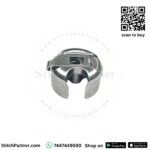
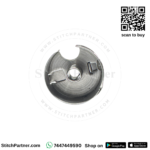
Best for: industrial units and tailor shops running Jack, Juki, or Umbrella-TA1 single-needle lockstitch machines who need a tight-tolerance BC-DB1 bobbin case — including a No-Back-Lash (NBL) spring option that stops bobbin thread from over-spinning and nesting when the machine stops abruptly.
This is a single needle BC-DB1-pattern bobbin case built to the DB1 hook system used across most Jack and Juki lockstitch machines sold in India, plus Umbrella-TA1 machines common in Ludhiana-region workshops. It comes in three grades — Medium, Premium, and Jack NBL — so you can match the part to how hard the machine runs rather than buying one generic case for every station.
Key Features and Advantages
- Tight-tolerance DB1 fit: machined to the same hook clearance as genuine Juki/Jack bobbin cases, so bobbin seating and rotation stay consistent instead of wobbling loose over time.
- Three quality grades: Medium for everyday replacement, Premium for a tougher finish under continuous factory use, and Jack NBL — which adds an anti-backlash spring — for machines prone to thread nesting.
- Anti-backlash spring (Jack NBL grade): a small spring-loaded disc at the base of the case that resists free-spinning when the machine stops suddenly — the actual mechanical cause of thread “bird’s-nesting” on the underside of the fabric.
- Cross-brand compatibility: the same DB1-pattern case fits Jack, Juki, and Umbrella-TA1 single-needle machines, so one SKU covers mixed-brand floors instead of stocking separate parts per brand.
Use Cases
Garment factories running multiple Jack or Juki lockstitch lines use this as a standard changeover part during routine maintenance. Tailor shops and boutique units running a single machine typically keep one Medium-grade case as backup and upgrade to Premium or Jack NBL only if they’re seeing nesting or tension complaints. Home users on an Umbrella-TA1 or similar machine use it as a like-for-like replacement when the original case wears out or the bobbin starts sitting loose.
Why This Bobbin Case
A worn or mismatched bobbin case is one of the most common causes of inconsistent lower-thread tension on lockstitch machines — not the tension screw, which is where most people start troubleshooting first. Because this case holds DB1-standard tolerances, it drops in without needing the tension screw re-adjusted from scratch, and the Jack NBL grade specifically addresses the over-spin problem that a standard case can’t.
Machine Compatibility
| Brand |
Compatible Models |
Notes |
| Juki |
DDL-8700, DDL-8700-7, DDL-5550(N), DDL-8300, DDL-8500, DDL-9000 |
Standard DB1-hook single needle lockstitch line |
| Jack |
F4, F5, A2, A3, A4, A5, JK-9100 |
Common single needle lockstitch models sold in India |
| Umbrella |
TA1 and similar single needle machines |
Widely used budget lockstitch machines in North India |
Specs
| Part type |
Bobbin case, lockstitch (BC-DB1 pattern) |
| Hook system |
DB1 standard |
| Grades available |
Medium / Premium / Jack NBL |
| Special feature (Jack NBL) |
Integrated anti-backlash (No-Back-Lash) spring |
| Fit |
Aftermarket, cross-compatible replacement — not OEM-branded |
| Price |
₹35–₹100 depending on grade |
How To Use
First, remove the old bobbin case by opening the hook cover and lifting the case out by its latch — never force it, as the hook race is precision-fit. Next, wipe the hook race clean of lint before inserting the new case, since trapped lint is the most common reason a new case still feels tight. Then seat the replacement case fully until the latch clicks and confirm the bobbin spins freely with light finger pressure. Finally, run a test seam on scrap fabric and check the underside stitch for even loops before returning the machine to production.
FAQ
Buyer Intent
Is this an OEM Juki or Jack part, or a compatible replacement?
It’s a compatible aftermarket replacement machined to DB1 standard, not an OEM-branded Juki or Jack part. It’s built to the same hook tolerances so it drops into machines expecting a genuine DB1 case, which is standard practice across the lockstitch spare-parts trade.
What’s the actual difference between Medium, Premium, and Jack NBL?
Medium is the standard-grade case for routine replacement. Premium uses a tougher finish for machines running continuous shifts. Jack NBL adds an anti-backlash spring on top of the Premium-grade body, specifically for machines that keep nesting thread at the start or stop of a seam.
Will this fit a machine that isn’t listed in the compatibility table?
If the machine uses a standard DB1 hook system — true of most single-needle lockstitch machines sold in India under Jack, Juki, or Umbrella branding — it will generally fit. If unsure, send a photo of the machine’s hook/bobbin area over WhatsApp for confirmation before ordering.
Compatibility
Does the same case work on both older Juki DDL-5550 and newer DDL-8700 machines?
Yes — Juki kept the same DB1 bobbin case design across the DDL-5550, DDL-8300, DDL-8500, DDL-8700, and DDL-9000 lines, so one case spec covers that entire model range rather than being generation-specific.
Is the Umbrella-TA1 version actually a different part from the Jack/Juki version?
No — Umbrella-TA1 machines use the same DB1-pattern hook system, so it’s the same physical case sold under the machine’s more common name for buyers searching by their machine brand rather than the hook standard.
Troubleshooting
Why does my machine “bird’s-nest” — loop thread underneath — when it starts or stops?
This is almost always the bobbin over-spinning for a fraction of a second when the machine stops abruptly, rather than a top-tension problem. A standard bobbin case has no resistance to stop that spin; the Jack NBL grade’s anti-backlash spring adds that resistance and is the direct fix rather than re-adjusting top tension repeatedly.
My lower thread is loose even after adjusting the tension screw — what else could it be?
Check the case itself before re-adjusting the screw further: a worn or ill-fitting case lets the bobbin sit slightly off-axis, which reads as a tension problem but isn’t fixed by tension adjustments. Swapping to a tight-tolerance DB1 case is often the actual fix once the tension screw is already in a reasonable range.
Maintenance
How do I know the anti-backlash spring needs replacing rather than just cleaning?
Press the bobbin gently while it’s seated in the case — a working spring gives a small, springy in-and-out movement. If there’s no bounce-back at all, the spring has lost tension (usually from trapped lint) and the case should be replaced rather than cleaned, since the spring itself isn’t a separately serviceable part.
How often should the bobbin case be cleaned vs. replaced?
Clean lint from the hook race and case every time the bobbin is changed — it takes seconds and prevents most premature wear. Replace the case itself when the bobbin no longer seats snugly or the anti-backlash spring stops giving resistance, typically a maintenance-interval item rather than a fixed calendar schedule since it depends on machine runtime.