Quick Answer
For most home and tailoring users, a servo motor (400W–550W) is the best sewing machine motor overall — it’s quiet, energy-efficient, and gives precise speed control via the foot pedal. Budget domestic setups still commonly use a 1/12 HP clutch/carbon motor (50W–120W, copper winding, 6500–9000 RPM), which is cheaper (₹400–₹1,500) but noisier and always spinning once powered on. Industrial straight-lock machines (including JACK models) increasingly ship with brushless servo motors for lower power bills and near-silent operation.
Jump to: Motor Types | Comparison Table | How to Choose | JACK Servo Motors | Troubleshooting | FAQ
What Does a Sewing Machine Motor Actually Do?
The motor is what turns your foot-pedal pressure into needle movement — it drives the belt, which spins the hand wheel and upper shaft. A weak, worn, or mismatched motor is one of the most common reasons a sewing machine runs roughly, hesitates, or won’t start at all.
Types of Sewing Machine Motors
1. Clutch Motors (Carbon Motors)
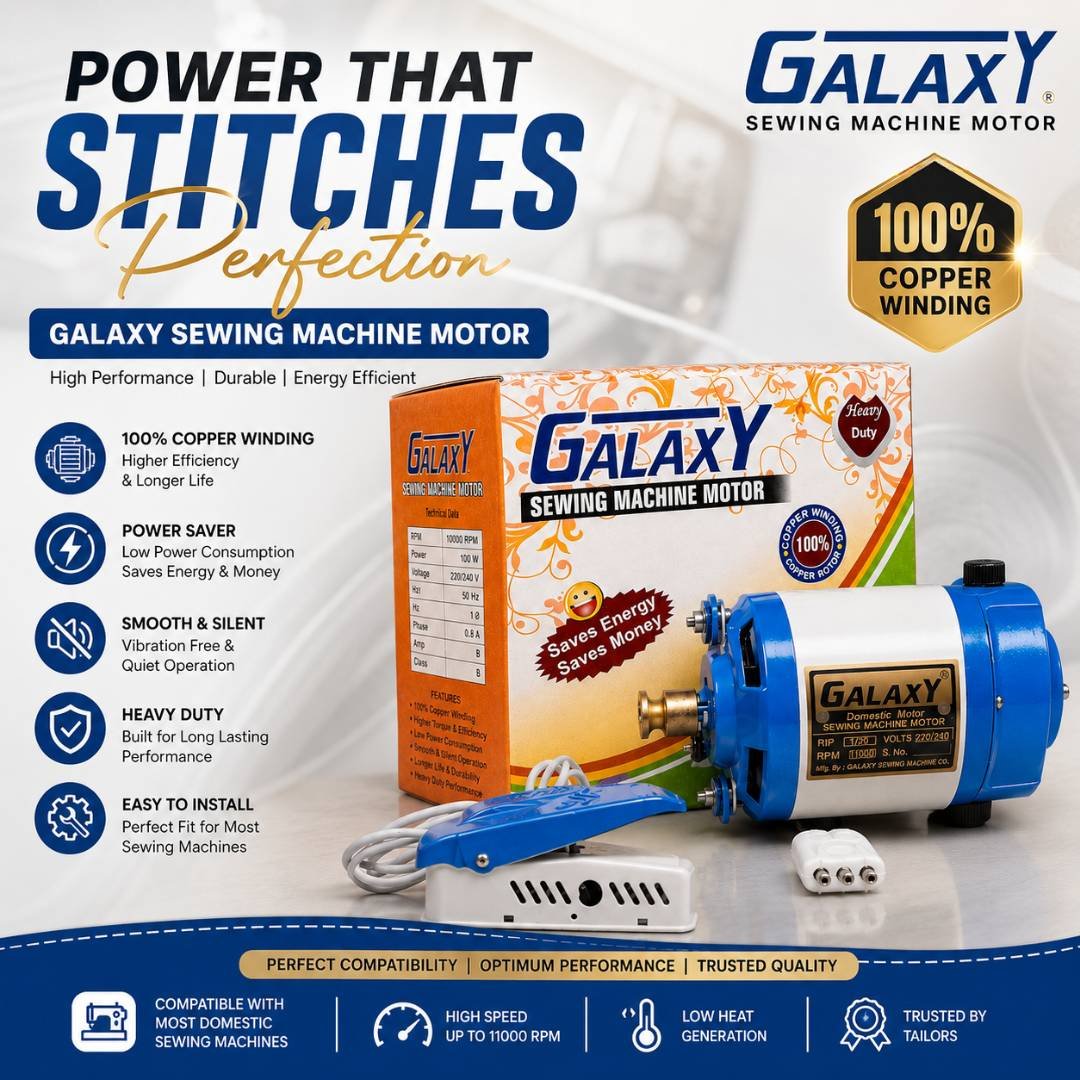
The traditional choice for domestic and entry-level industrial machines. A clutch motor spins continuously once the machine is switched on; engaging the pedal simply connects it to the drive via a mechanical clutch.
- Pros: Low upfront cost, high torque, simple to repair, widely available
- Cons: Always spinning (wastes electricity), noisier, generates more heat, less precise low-speed control
- Best for: Budget home setups, basic straight-stitch tailoring, occasional use
Shop clutch/carbon motors: Domestic Sewing Machine Carbon Motor Set with Foot Pedal or the Big Heavy-Duty Carbon Motor Set with Foot Regulator for tougher daily use.
2. Servo Motors
Servo motors only draw significant power and spin when the foot pedal is pressed, and stop almost instantly when released. They give much smoother acceleration and far more control at low speeds.
- Pros: Energy-efficient, quiet, cooler running, precise speed control, longer working life
- Cons: Higher upfront cost, needs a compatible mount/control box
- Best for: Daily tailoring use, boutiques, industrial straight-lock and overlock machines, noise-sensitive environments
Shop servo motor control boards: Direct Drive Servo Motor Control Board or the ESDA Servo Motor PCB Control Board.
3. Brushless DC Servo Motors
The newer generation used in computerized and premium industrial machines. No carbon brushes to wear out, near-silent, and the most power-efficient option, but priced higher and less common in basic repair-shop stock.
Shop carbonless (brushless-style) motors: Carbonless Sewing Machine Motor with Foot Pedal.
Clutch vs Servo vs Brushless: Comparison Table
| Feature |
Clutch Motor |
Servo Motor |
Brushless Servo |
| Typical power |
50W–150W |
400W–750W |
400W–550W |
| Noise level |
High |
Low |
Very low |
| Runs idle when on? |
Yes, continuously |
No, only on pedal press |
No |
| Energy use |
Higher (wastes power idling) |
Lower |
Lowest |
| Low-speed control |
Weak |
Precise |
Very precise |
| Typical price (India) |
₹400–₹1,500 |
₹2,500–₹3,500 |
₹4,000+ |
| Best for |
Budget/home use |
Daily tailoring, industrial |
Premium industrial/computerized |
How to Choose the Right Motor
1. Match the HP/Wattage to your machine
Domestic mini motors are typically 1/12 HP to 1/16 HP (50W–120W). Industrial machines generally need 250W–550W servo motors for consistent torque through thicker fabric like denim or multiple layers.
2. Check RPM range
Most domestic motors run 6,500–9,000 RPM. Higher RPM isn’t automatically better — what matters more is smooth control at low speed, which is where servo motors outperform clutch motors.
3. Confirm voltage compatibility
Indian household and workshop supply is typically 220–240V, 50Hz. Always match this to the motor’s rated voltage/frequency before buying to avoid burnout.
4. Copper winding vs standard winding
Full copper-winding motors run cooler and last longer under continuous use than motors with cheaper aluminium or mixed windings — worth the small price difference for daily-use tailoring.
5. Mounting and belt compatibility
Check that the motor’s mounting bracket and pulley size suit your machine frame; servo motor control boxes need a bit more space than a compact clutch motor. If you’re also adjusting or replacing the hand wheel during installation, see our guide on how to use the Usha Allure hand wheel.
Typical Sewing Machine Motor Prices in India (2026)
- Basic 1/12 HP clutch/carbon motor: ₹400 – ₹1,500
- Mid-range copper-winding motor with regulator: ₹1,000 – ₹2,100
- Servo motor (400W–550W): ₹2,500 – ₹3,500
- Heavy-duty/branded industrial servo motor: ₹4,000 – ₹10,000+
Prices vary by brand, wattage, and seller; treat this as a directional range rather than a live quote.
JACK Servo Motors: What to Know
JACK is one of the most widely used industrial sewing machine brands in India, and its servo motors are a common upgrade path for older clutch-driven machines. Typical specs on popular JACK servo models (e.g. JK-513A, PSM 550W) run around 550W power, ~4,500 RPM, 50Hz/220V, paired with a control box and pedal rod. Manufacturers commonly market these as delivering roughly 60-70% energy savings versus a constantly-spinning clutch motor, since the servo only draws full power while the pedal is pressed.
Tailors who switch from an old clutch motor to a servo motor typically report the biggest difference at low speed – smoother starts, far less vibration, and noticeably quieter operation, especially on long shifts. If your JACK machine’s control box or PCB has failed rather than the motor itself, check our JACK 9100B 904A PCB Control Board or JACK 781G Main PCB Control Board before replacing the whole motor.
Common Sewing Machine Motor Problems (and Fixes)
Motor hums but doesn’t turn
This usually means the motor is receiving power but a bearing is locked or resistance is too high for the torque available. Try nudging the hand wheel by hand while pressing the pedal. If it still won’t turn freely, the motor likely needs replacing.
Motor makes no sound and doesn’t run at all
Check the foot pedal wiring and connections first — this is often a wiring or pedal fault rather than the motor itself. If wiring checks out with a multimeter and there’s still no response, it’s usually an internal motor fault.
Loud hum only at start, then quiet
Common on older clutch motors: torque is weakest at the very start of a stitch (e.g., needle at top position). Lubricating the motor’s oil points and checking brush contact with the commutator usually resolves this.
Machine runs but needle/feed doesn’t move
This points to the belt or drive mechanism, not the motor itself — check belt tension and condition before replacing the motor.
Motor Maintenance Tips
- Oil motor bearings periodically per the manufacturer’s schedule (over-oiling attracts lint/dust)
- Keep the motor area free of thread lint and dust buildup
- Check belt tension regularly — a too-tight belt strains the motor
- For clutch motors, switch off at the wall when not sewing rather than leaving it idling
Frequently Asked Questions
Is a servo motor better than a clutch motor for a sewing machine?
For most users, yes — servo motors are quieter, more energy-efficient, and give better control, especially at low speeds. Clutch motors remain a valid budget choice for light, occasional use.
What HP motor do I need for a home sewing machine?
Most domestic machines use a 1/12 HP to 1/16 HP motor (50–120W). Industrial or heavy-fabric use typically needs 250W or higher.
How long do sewing machine motors last?
Clutch motors typically last 5–10 years with regular use; servo motors often exceed 10 years due to reduced wear and better thermal management.
Can I replace a clutch motor with a servo motor?
In many cases yes, provided the machine frame supports the mount and there’s room for the control box. Professional installation is recommended if you’re unsure.
Why is my sewing machine motor making a loud humming noise?
Usually a torque/resistance issue at low speed, a lubrication problem, or worn brushes/bearings. See the troubleshooting section above before replacing the motor.
How much electricity does a servo motor save over a clutch motor?
Manufacturers commonly claim around 60-70% lower power consumption, since a servo motor only draws significant current when the pedal is pressed, unlike a clutch motor that spins continuously whenever the machine is switched on.
Do JACK sewing machine motors fit other machine brands?
Many JACK servo motors and control boards are compatible with other industrial straight-lock machines given matching mount and shaft specifications, but always confirm bracket, pulley, and control-box fitment against your specific machine model before ordering.
This guide is maintained by Stitch Partner, sourcing and supplying JACK sewing machine spare parts. [Author/credential details to be added by site owner for full E-E-A-T compliance.]