Blog
JACK vs Juki Sewing Machine: India Buying Guide

Quick Answer
Juki is the Japanese legacy brand. It’s known for precision, long-term durability, and a reputation as the reference standard in professional garment factories. JACK is the China-based volume leader. It’s known for modern features (direct-drive servo motors, automatic thread trimmers, power-saving technology), a wide model range, and faster growth. Together, JACK and Juki account for the large majority of new industrial sewing machine sales in India today. Many established Indian factories run both side by side — Juki on precision-critical operations, JACK for cost-effective scaling. Because each brand fails differently, the right pick often depends on which machine class you’re buying for, not brand loyalty alone.

About JACK Sewing Machine Co.
JACK Sewing Machine Co., Ltd was founded in 1995 in Taizhou, Zhejiang, China. Since 2010, JACK has held the position of the world’s largest sewing machine company by unit volume, selling through thousands of resellers across more than 100 countries. The company is publicly listed on the Shanghai Stock Exchange. It has acquired several established European manufacturers, including Germany’s Bullmer and Italy’s Vibemac, to expand its cutting and automation technology.
JACK’s product range spans lockstitch, overlock, interlock, heavy-duty, and specialty machines, alongside automatic cutters and energy-saving servo motors. The brand is particularly known in India for modern features at accessible price points, making it a popular choice for growing workshops and factories upgrading from older clutch-motor machines.
About Juki Corporation
Juki Corporation traces its roots to 1938 in Tokyo, Japan. It was originally formed as the Tokyo Juki Manufacturers Association before becoming an independent industrial sewing machine maker. With over 85 years of engineering history, Juki is widely regarded as the benchmark for stitch precision and long service life in professional garment production.
Juki machines are manufactured across factories in Japan, China, and Vietnam, and sold in around 170 countries. In India specifically, Juki’s single-needle lockstitch machines have a long-standing reputation among sample rooms and precision-critical operations. Consistent stitch quality directly affects buyer approval.
JACK vs Juki Sewing Machine: Side-by-Side Comparison
| Factor | JACK | Juki |
|---|---|---|
| Origin | China (founded 1995) | Japan (founded 1938) |
| Global position | Largest by unit volume since 2010 | Legacy precision leader, ~170 countries |
| Known for | Modern features, servo/energy-saving tech, wide model range | Stitch precision, long-term durability, consistency |
| Typical India role | Cost-effective scaling, growing workshops | Sample rooms, precision-critical operations |
| Machine range | Lockstitch, overlock, interlock, heavy-duty, specialty, cutting | Lockstitch, overlock, interlock, heavy-duty, household |
| Spare parts & service network | Wide reseller network, strong in India | Long-established India distribution |

Which Brand Should You Choose?
The honest answer depends on what the machine is doing in your workflow, not brand loyalty alone. Many experienced Indian garment manufacturers run a hybrid setup rather than committing to one brand exclusively.
Choose Juki when:
- Stitch precision directly affects buyer approval (sample rooms, export orders)
- The machine will run continuously for years under heavy daily load
- You prioritize long-term durability over upfront cost savings
Choose JACK when:
- You’re scaling up production and need more machines per rupee of investment
- You want modern features like direct-drive servo motors and automatic thread trimming as standard
- You’re upgrading from an older clutch-motor machine and want energy-efficient technology
What Machine Owners Actually Report
Beyond brand marketing, real operator feedback consistently points to a few patterns. Juki owners frequently highlight low vibration, quiet operation, and smooth high-speed performance. Several note that Juki-made overlockers historically included automatic threading technology before it became common industry-wide. JACK owners tend to highlight value for money and how quickly modern features filtered down to affordable price points, which matters most for workshops scaling up quickly. Both brands have a strong reputation for running well over a decade with proper maintenance.
From our side of the counter, the pattern is pretty consistent: when a factory calls us for JACK parts, it’s usually a control board or motor issue on a newer machine still under heavy daily use. When it’s Juki, it’s more often an older machine, still running fine mechanically, just needing a worn part swapped after years of service. Neither is “better” so much as they fail differently — and that difference is exactly why so many shops run both.
Spare Parts & Long-Term Serviceability
Machine choice matters, but so does what happens when a part fails. This is where a lot of factories get caught out. A precision machine is only as good as your access to genuine replacement parts when a PCB board, motor, or presser foot wears out.
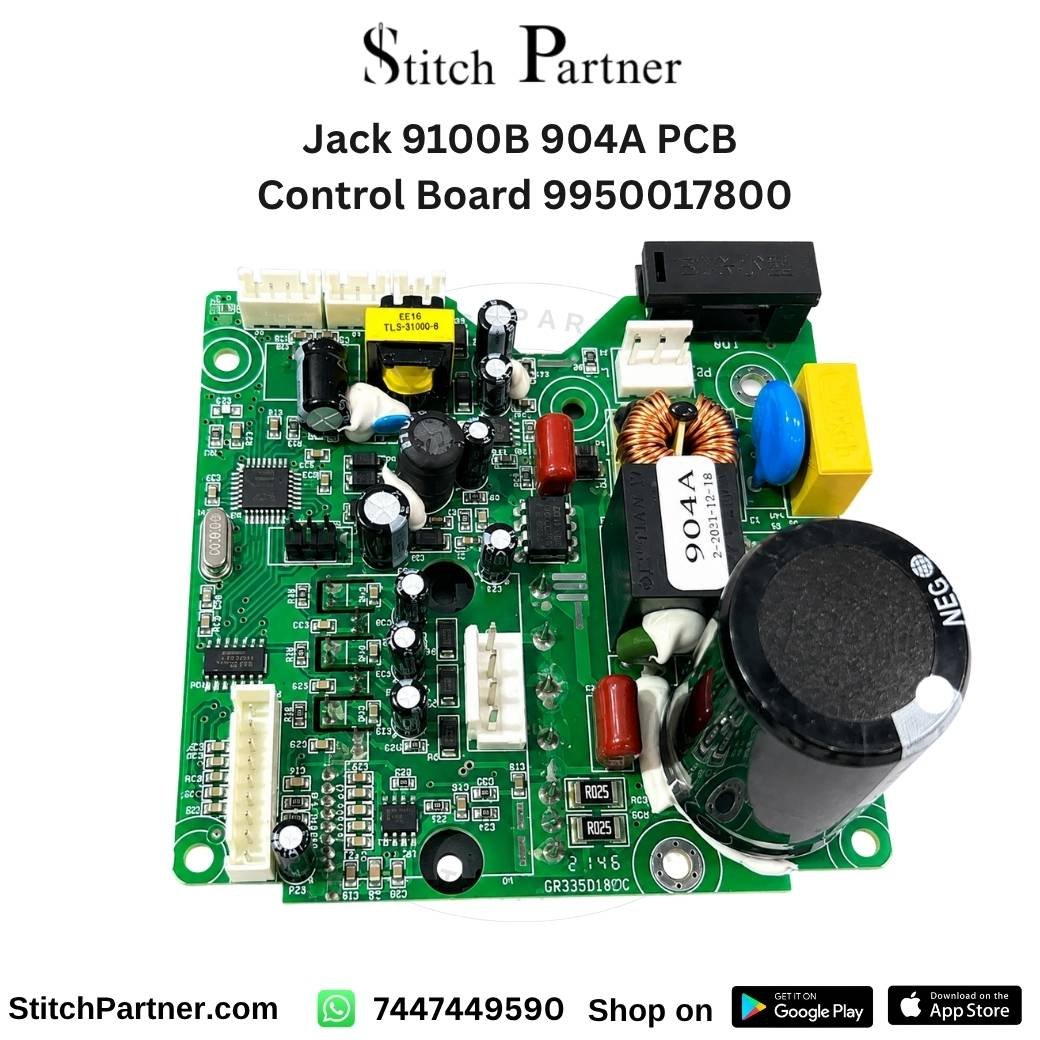
We stock genuine and compatible spare parts for both brands: browse the JACK Sewing Machine Spare Parts range or the Juki Sewing Machine Spare Parts range. For electronics specifically, our Direct Drive Servo Motor Control Board and JACK 9100B 904A PCB Control Board are common replacement parts for direct-drive models from either brand family. If you need model-specific part diagrams, our JACK Parts Books and Juki Parts Books cover exploded part views by model.

Keeping Either Brand Running Longer
- Oil moving parts on the manufacturer’s recommended schedule — both brands suffer more from under-oiling than over-use
- Replace worn presser feet and needle plates promptly; delaying this often damages the hook timing next
- Keep servo motor control boxes free of thread lint and dust, since airflow blockage is a common cause of PCB failure
- Use genuine or verified-compatible parts — mismatched tolerances on gears and hooks are a frequent cause of premature wear on both JACK and Juki machines
Frequently Asked Questions
Is JACK as good as Juki?
JACK has closed much of the historical quality gap and now leads globally by unit volume, but Juki still holds an edge in long-term precision consistency for the most demanding, buyer-approval-critical work. For most day-to-day production, both are reliable choices.
Which brand has better spare parts availability in India?
Both brands have strong, well-established India distribution networks. JACK’s rapid market growth over the last decade means its parts are increasingly easy to source; Juki’s longer India presence means a deep base of experienced technicians familiar with its machines.
Can I mix JACK and Juki machines in the same factory?
Yes — this is common practice among established Indian manufacturers, who often assign each brand to the operations where its strengths matter most rather than standardizing on a single brand.
How long do JACK and Juki industrial machines typically last?
Both brands can run well over a decade in normal factory use with proper maintenance and genuine replacement parts.
Related guides: Needle System Guide | Presser Foot Types Guide | Maintenance Checklist
Written by Aashu, owner of Stitch Partner. We’ve spent years sourcing genuine JACK and Juki spare parts for factories, boutiques, and home tailors across India — this guide reflects what actually comes through our shop, not just spec sheets.


